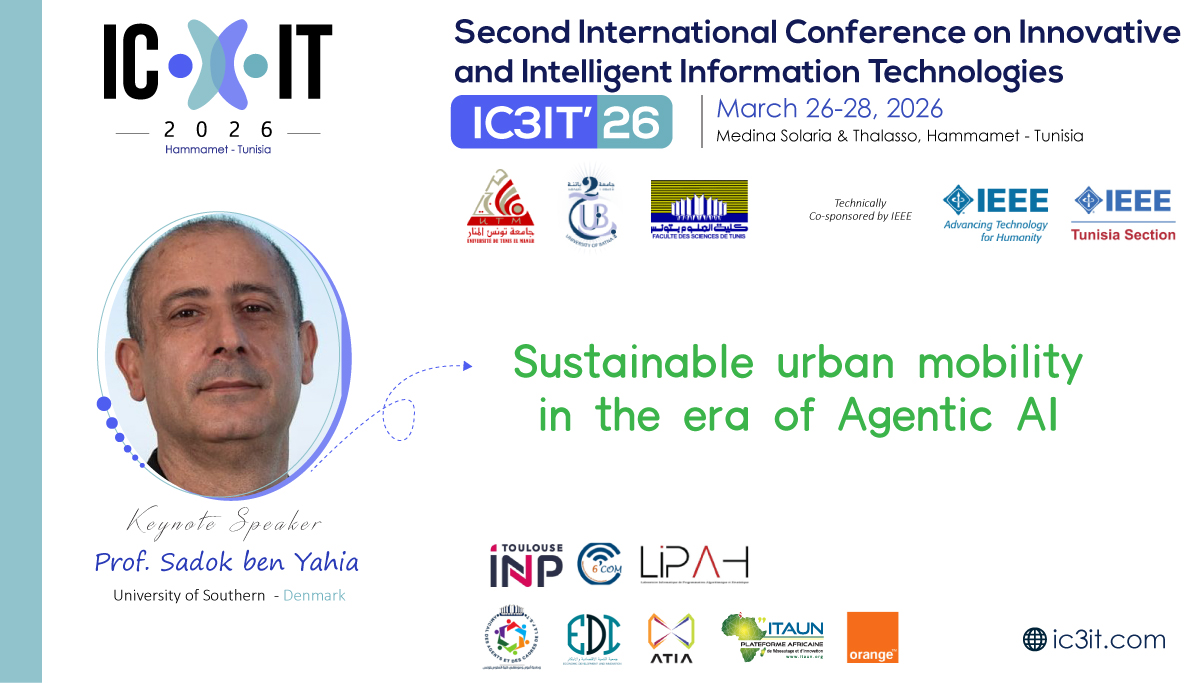
Second International Conference on Innovative and Intelligent Information Technologies – IC3IT’26
- March 26-28, 2026
- Medina Solaria & Thalasso, Hammamet – Tunisia
Prof. Sadok Ben Yahia, University of Southern Denmark.
Title: Sustainable urban mobility in the era of Agentic AI
Abstract:
Rapid urban population growth has led to a sharp increase in mobility demand, placing unprecedented pressure on urban transport systems and creating major challenges for the development of sustainable and liveable cities. Traffic congestion remains one of the most critical barriers to sustainable urban mobility, driving excessive energy consumption, increased greenhouse gas (GHG) emissions, economic losses, and a decline in overall quality of life. Addressing these challenges requires intelligent, data-driven solutions that combine efficient public transport, adaptive traffic management, and advanced digital technologies.
In this talk, we explore how Artificial Intelligence (AI)—specifically Large Language Models (LLMs) integrated with Reinforcement Learning (RL) and Vehicle-to-Everything (V2X) communication—can enable next-generation Intelligent Traffic Management (ITM) systems for sustainable urban mobility. We focus on agentic AI frameworks that move beyond reactive control toward context-aware, adaptive, and scalable decision-making in complex urban environments.
We first present an LLM-based Agentic ReAct Bus Eco-Driving Framework (LARBEF) for the public transport sector. In this framework, an RL-driven agent leverages V2X communication and real-time contextual information—such as road slope, passenger load, ambient temperature, traffic signal states, and queue length—to optimise eco-driving strategies for different bus technologies, including conventional diesel, electric, and plug-in hybrid electric buses. The proposed approach reduces energy consumption and emissions while maintaining service reliability and passenger comfort.
We then introduce MARLATS, a Model Context Protocol–based Agentic ReAct LLM framework for adaptive traffic signal control in large-scale urban networks. MARLATS combines LLM-based reasoning with RL-driven control and V2X-enabled sensing to dynamically coordinate traffic signals in response to evolving traffic conditions. The framework improves traffic efficiency, reduces energy use and emissions, and enhances economic performance at the network level.
Overall, this talk demonstrates how integrating agentic LLM reasoning with reinforcement learning and connected vehicle technologies can transform both vehicle-level and network-level mobility management. The presented frameworks highlight the potential of AI-driven mobility systems to support cleaner, more efficient, and more inclusive urban transport, contributing to the long-term sustainability of future cities.
Biography:
Sadok BEN YAHIA is a Full Professor at the Southern Denmark University (SDU) since September 2023. Before joining SDU, he was a full professor at the Technology University of Tallinn (TalTech) since January 2019. He obtained his HDR in Computer Sciences from the University of Montpellier (France) in April 2009. His research interests mainly focus on trustworthy and safe LLM-based AI systems and their application to urban mobility in smart cities (e.g., information aggregation and dissemination and traffic congestion prediction), Recommendation Systems, and fake content fighting.
