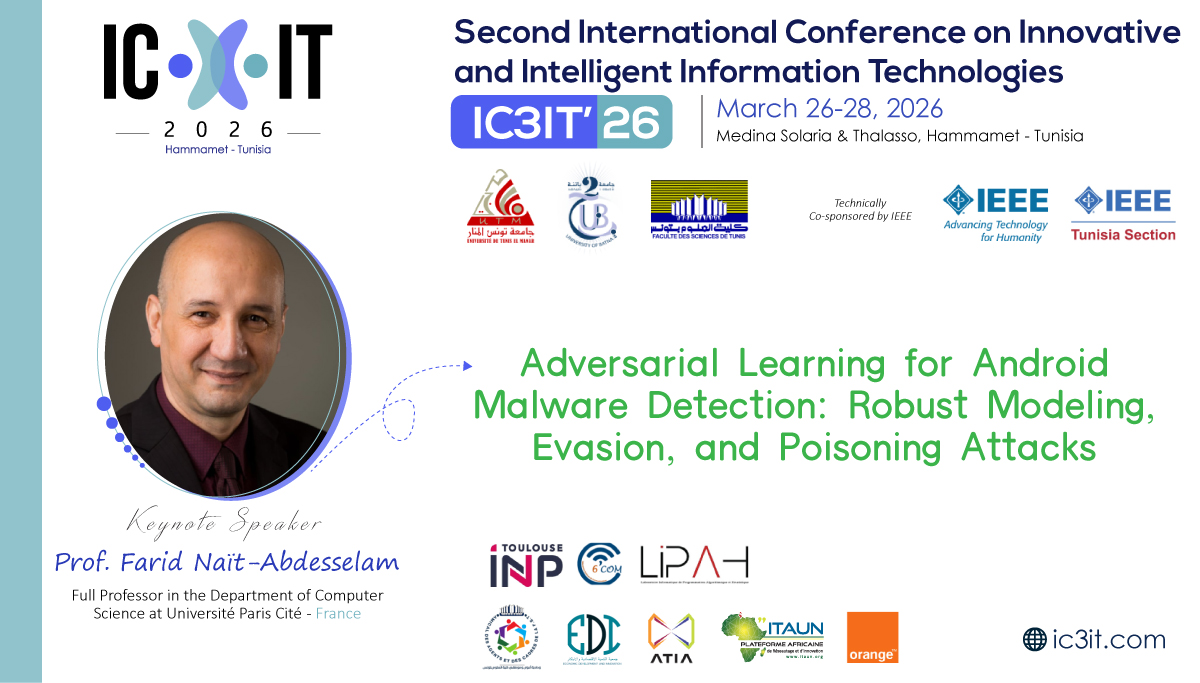
Second International Conference on Innovative and Intelligent Information Technologies – IC3IT’26
- March 26-28, 2026
- Medina Solaria & Thalasso, Hammamet – Tunisia
Prof. Farid Naït-Abdesselam, Professor at Université Paris Cité, France.
Title: Adversarial Learning for Android Malware Detection: Robust Modeling, Evasion, and Poisoning Attacks
Abstract :
The widespread adoption of Android smartphones has made mobile malware detection a critical cybersecurity challenge. Machine learning techniques have become central to Android malware detection due to their scalability and adaptability. However, as these systems are increasingly deployed, attackers have shifted their focus toward exploiting weaknesses in the learning process itself, turning malware detection into an adversarial problem.
This keynote explores adversary-aware approaches to Android malware detection, examining both robust detection strategies and emerging attack models. It discusses how representation learning and intelligent application transformations can improve resilience against evasion, while highlighting the vulnerability of current systems to adversarial manipulation. The talk also addresses data poisoning and label-spoofing attacks, as well as the growing impact of large language models in automating sophisticated evasion strategies. The keynote concludes with a discussion of defensive mechanisms and open challenges in building robust, trustworthy, and future-ready Android malware detection systems.
Biography:
Farid Naït-Abdesselam is a Full Professor at Université Paris Cité. He received the State Engineering degree from the University of Science and Technology Houari Boumediene, Algeria, in 1993, an M.S. degree from Université René Descartes [now Université Paris Cité], France, in 1994, and a Ph.D. degree from Université de Versailles Saint-Quentin-en-Yvelines [now Paris-Saclay University], France, in 2000, all in Computer Science.
His research focuses on secure communication systems, network resilience and optimization, intrusion detection, and adaptive defense strategies in complex, constrained, and heterogeneous environments. He has authored over 180 peer-reviewed publications, edited two scientific books, and contributed several book chapters on advanced topics including network security, malware forensics, and blockchain technology. His work bridges theoretical foundations and practical deployments across mobile, vehicular, drone, and large-scale networked systems.
