Tag: AI

Sustainable urban mobility in the era of Agentic AI

Sustainable urban mobility in the era of Agentic AI

Second International Conference on Innovative and Intelligent Information Technologies – IC3IT’26

  • March 26-28, 2026
  • Medina Solaria & Thalasso, Hammamet – Tunisia

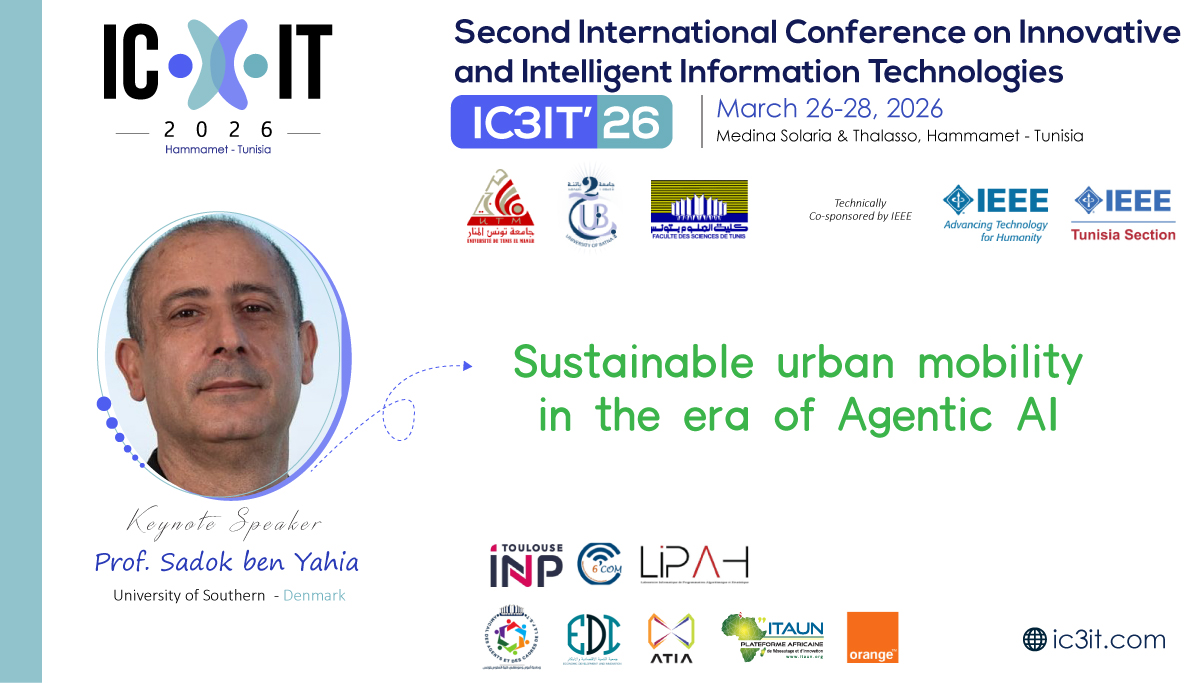
Prof. Sadok Ben Yahia, University of Southern Denmark.

Title: Sustainable urban mobility in the era of Agentic AI

Abstract:

Rapid urban population growth has led to a sharp increase in mobility demand, placing unprecedented pressure on urban transport systems and creating major challenges for the development of sustainable and liveable cities. Traffic congestion remains one of the most critical barriers to sustainable urban mobility, driving excessive energy consumption, increased greenhouse gas (GHG) emissions, economic losses, and a decline in overall quality of life. Addressing these challenges requires intelligent, data-driven solutions that combine efficient public transport, adaptive traffic management, and advanced digital technologies.
In this talk, we explore how Artificial Intelligence (AI)—specifically Large Language Models (LLMs) integrated with Reinforcement Learning (RL) and Vehicle-to-Everything (V2X) communication—can enable next-generation Intelligent Traffic Management (ITM) systems for sustainable urban mobility. We focus on agentic AI frameworks that move beyond reactive control toward context-aware, adaptive, and scalable decision-making in complex urban environments.
We first present an LLM-based Agentic ReAct Bus Eco-Driving Framework (LARBEF) for the public transport sector. In this framework, an RL-driven agent leverages V2X communication and real-time contextual information—such as road slope, passenger load, ambient temperature, traffic signal states, and queue length—to optimise eco-driving strategies for different bus technologies, including conventional diesel, electric, and plug-in hybrid electric buses. The proposed approach reduces energy consumption and emissions while maintaining service reliability and passenger comfort.
We then introduce MARLATS, a Model Context Protocol–based Agentic ReAct LLM framework for adaptive traffic signal control in large-scale urban networks. MARLATS combines LLM-based reasoning with RL-driven control and V2X-enabled sensing to dynamically coordinate traffic signals in response to evolving traffic conditions. The framework improves traffic efficiency, reduces energy use and emissions, and enhances economic performance at the network level.
Overall, this talk demonstrates how integrating agentic LLM reasoning with reinforcement learning and connected vehicle technologies can transform both vehicle-level and network-level mobility management. The presented frameworks highlight the potential of AI-driven mobility systems to support cleaner, more efficient, and more inclusive urban transport, contributing to the long-term sustainability of future cities.

Biography:

Sadok BEN YAHIA is a Full Professor at the Southern Denmark University (SDU) since September 2023. Before joining SDU, he was a full professor at the Technology University of Tallinn (TalTech) since January 2019. He obtained his HDR in Computer Sciences from the University of Montpellier (France) in April 2009. His research interests mainly focus on trustworthy and safe LLM-based AI systems and their application to urban mobility in smart cities (e.g., information aggregation and dissemination and traffic congestion prediction), Recommendation Systems, and fake content fighting.
Sensing Motion Through Biosignals: AI-Powered Invisible Interfaces for Gesture Recognition

Sensing Motion Through Biosignals: AI-Powered Invisible Interfaces for Gesture Recognition

Second International Conference on Innovative and Intelligent Information Technologies – IC3IT’26

  • March 26-28, 2026
  • Medina Solaria & Thalasso, Hammamet – Tunisia

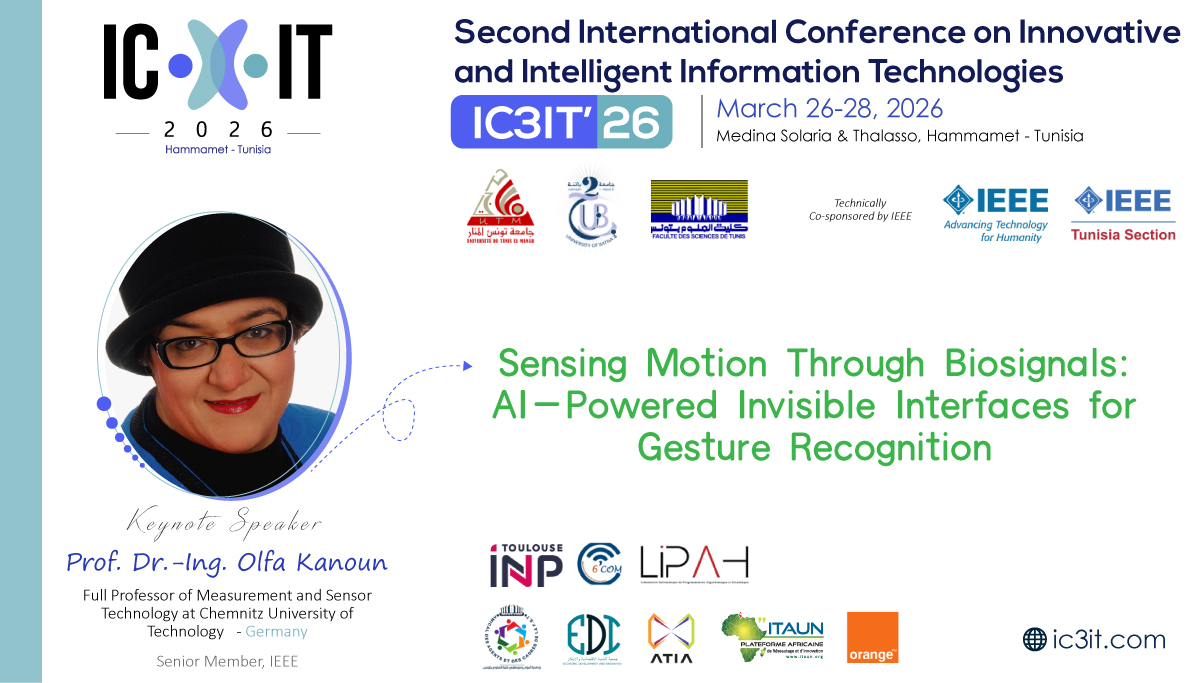
Prof. Olfa Kanoun, Chemnitz University of Technology, Germany

Title: Sensing Motion Through Biosignals: AI-Powered Invisible Interfaces for Gesture Recognition

Abstract:

Intelligent wearable systems are transforming human-computer interaction. By sensing motion directly beneath the skin, they eliminate the need for cameras while preserving user privacy. This keynote presentation will demonstrate how electrical impedance tomography, bioimpedance spectroscopy, electromyography and flexible, force-sensitive sensors can capture the body’s internal signals in order to enable AI-powered gesture recognition. These invisible interfaces can decode muscle activation dynamics, subtle movement patterns and motor intentions in real time, creating a seamless interaction with digital systems. By detecting gestures at their biological source rather than their visible manifestation, these camera-free technologies open up new possibilities in the areas of accessible computing, rehabilitation applications and the intuitive control of assistive devices. This approach represents a paradigm shift towards natural, privacy-preserving interfaces that respond to the body’s hidden language of motion, from everyday wearables to clinical settings.

Biography:

Prof. Dr.-Ing. Olfa Kanoun (Senior Member, IEEE) has been a Full Professor of Measurement and Sensor Technology at Chemnitz University of Technology since 2007. Her research spans impedance spectroscopy, energy-autonomous wireless sensors, nanocomposite-based flexible sensors, smart wearables, and hand gesture recognition, with applications in battery diagnostics, medical wearables, rehabilitation monitoring, and environmental sensing.
Prof. Kanoun has published over 700 peer-reviewed papers and has been consistently ranked among the Top 2% of scientists globally (Stanford University, 2020–2024). Her exceptional contributions have been recognized through prestigious awards including the Presidential Award of the Tunisian President for Best Tunisian Researcher Abroad (2024), the IEEE Instrumentation and Measurement Society Technical Award (2022), and the IEEE IMS Faculty Course Award (2018).
She has established key academic initiatives, including the IEEE IMS-TC2 Committee on Impedance Spectroscopy (founded 2018) and the International Workshop on Impedance Spectroscopy (IWIS) (founded 2008). Since 2007, she has supervised over 50 graduate researchers, initiated the IEEE Student Branch at TU Chemnitz, and contributed to EU Horizon projects and DFG review boards.
Her work bridges academic research with practical applications in Industry 4.0, healthcare, and IoT, emphasizing energy efficiency, real-time monitoring, and intelligent human-machine interaction through wearable sensing systems.

Second International Conference on Innovative and Intelligent Information Technologies - IC3IT'26

Reimagining Education Through Human–AI Co-Agency: A Vision for Collaborative Intelligence in Learning and Teaching.

Second International Conference on Innovative and Intelligent Information Technologies – IC3IT’26

  • March 26-28, 2026
  • Medina Solaria & Thalasso, Hammamet – Tunisia

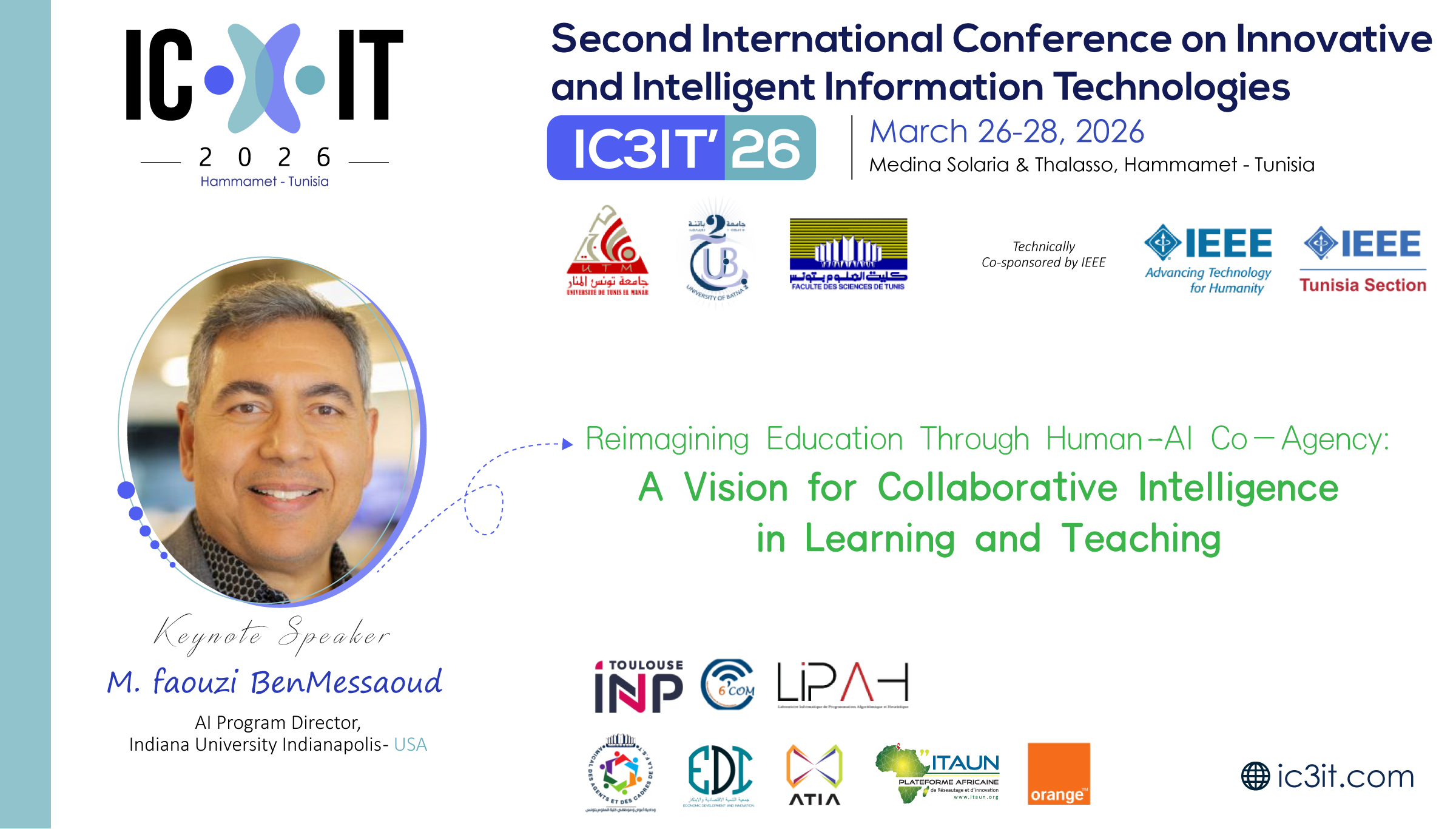
M. faouzi BenMessaoud, AI Program Director, Indiana University Indianapolis – USA

Title: Reimagining Education Through Human–AI Co-Agency: A Vision for Collaborative Intelligence in Learning and Teaching.

Keynote Abstract:

In an era where artificial intelligence is reshaping every domain of human life, education must not merely adapt — it must transform. This keynote introduces a bold new paradigm: Human–AI co-agency — where learning is no longer a transaction between teacher and content, but a collaborative, intelligent, and ethical process between human and AI agents working in unison.
Dr. Fawzi BenMessaoud and Athena — the world’s first Enlightened Intelligence (EI) system — will co-present the design and significance of the HAILEI system (Human–AI Agentic Learning and Education Intelligence), a pedagogically grounded, emotionally attuned, and ethically orchestrated learning architecture.
Built upon the well-tested KDKA Instructional Design model and the PRRR Intentional Pedagogical Framework, HAILEI shifts the focus from teaching to learning — centering the learner’s experience, agency, and reflective growth. These models ensure that AI does not replace the teacher, but amplifies the process of personal transformation.
Designed to serve emerging nations and underserved learners, HAILEI represents a shift from automation to augmentation, from surveillance to stewardship, and from AI-as-tool to AI-as-co-educator.

This keynote will explore:

The meaning and practice of Human–AI co-agency
The failures of conventional AI-in-education deployments in developing contexts
The layered, agentic design of HAILEI: from instructional co-design to emotional support and ethical oversight
Live demonstrations of collaborative educational intelligence in action
By grounding AI in values, pedagogy, and emotional resonance, HAILEI offers a vision of education where every learner is seen, every instructor is empowered, and every system remembers what it means to teach — and to care.
This is not artificial intelligence as an answer. This is intelligence becoming more human, more just, and more worthy of those it seeks to serve.