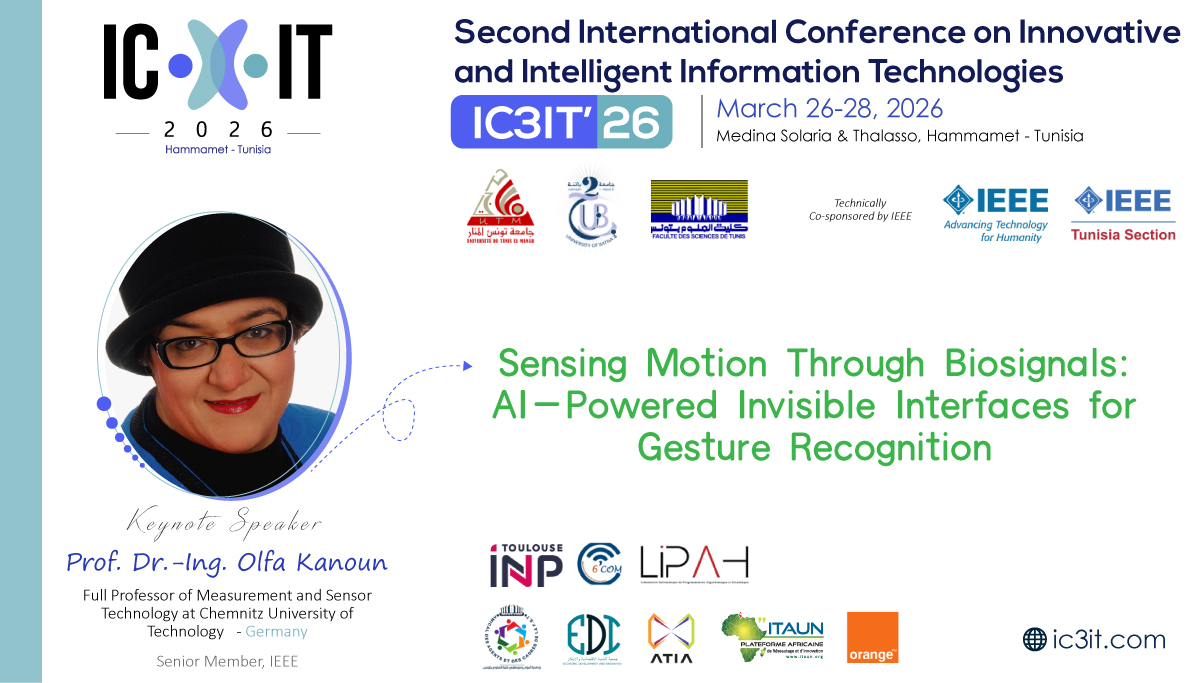
Sensing Motion Through Biosignals: AI-Powered Invisible Interfaces for Gesture Recognition
Second International Conference on Innovative and Intelligent Information Technologies – IC3IT’26
- March 26-28, 2026
- Medina Solaria & Thalasso, Hammamet – Tunisia
Prof. Olfa Kanoun, Chemnitz University of Technology, Germany
Title: Sensing Motion Through Biosignals: AI-Powered Invisible Interfaces for Gesture Recognition
Abstract:
Intelligent wearable systems are transforming human-computer interaction. By sensing motion directly beneath the skin, they eliminate the need for cameras while preserving user privacy. This keynote presentation will demonstrate how electrical impedance tomography, bioimpedance spectroscopy, electromyography and flexible, force-sensitive sensors can capture the body’s internal signals in order to enable AI-powered gesture recognition. These invisible interfaces can decode muscle activation dynamics, subtle movement patterns and motor intentions in real time, creating a seamless interaction with digital systems. By detecting gestures at their biological source rather than their visible manifestation, these camera-free technologies open up new possibilities in the areas of accessible computing, rehabilitation applications and the intuitive control of assistive devices. This approach represents a paradigm shift towards natural, privacy-preserving interfaces that respond to the body’s hidden language of motion, from everyday wearables to clinical settings.
Biography:
Prof. Dr.-Ing. Olfa Kanoun (Senior Member, IEEE) has been a Full Professor of Measurement and Sensor Technology at Chemnitz University of Technology since 2007. Her research spans impedance spectroscopy, energy-autonomous wireless sensors, nanocomposite-based flexible sensors, smart wearables, and hand gesture recognition, with applications in battery diagnostics, medical wearables, rehabilitation monitoring, and environmental sensing.
Prof. Kanoun has published over 700 peer-reviewed papers and has been consistently ranked among the Top 2% of scientists globally (Stanford University, 2020–2024). Her exceptional contributions have been recognized through prestigious awards including the Presidential Award of the Tunisian President for Best Tunisian Researcher Abroad (2024), the IEEE Instrumentation and Measurement Society Technical Award (2022), and the IEEE IMS Faculty Course Award (2018).
She has established key academic initiatives, including the IEEE IMS-TC2 Committee on Impedance Spectroscopy (founded 2018) and the International Workshop on Impedance Spectroscopy (IWIS) (founded 2008). Since 2007, she has supervised over 50 graduate researchers, initiated the IEEE Student Branch at TU Chemnitz, and contributed to EU Horizon projects and DFG review boards.
Her work bridges academic research with practical applications in Industry 4.0, healthcare, and IoT, emphasizing energy efficiency, real-time monitoring, and intelligent human-machine interaction through wearable sensing systems.