Tag: Learning

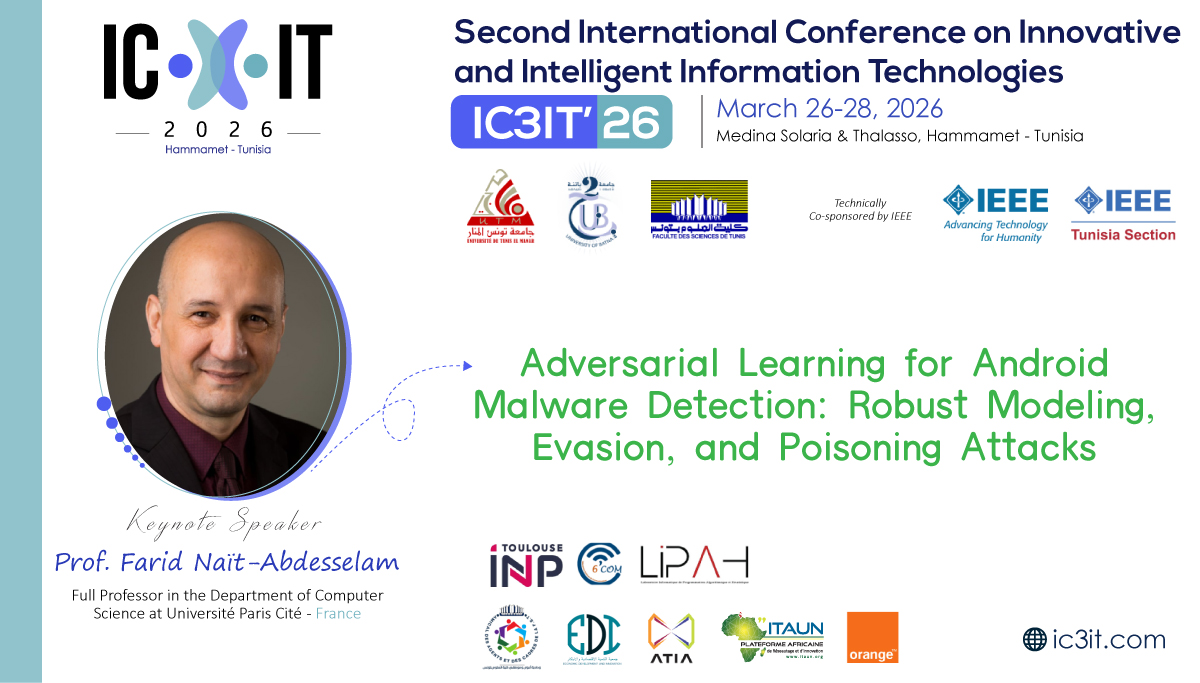
Adversarial Learning for Android Malware Detection: Robust Modeling, Evasion, and Poisoning Attacks

Adversarial Learning for Android Malware Detection: Robust Modeling, Evasion, and Poisoning Attacks

Second International Conference on Innovative and Intelligent Information Technologies – IC3IT’26

  • March 26-28, 2026
  • Medina Solaria & Thalasso, Hammamet – Tunisia

Prof. Farid Naït-Abdesselam, Professor at Université Paris Cité, France.

Title: Adversarial Learning for Android Malware Detection: Robust Modeling, Evasion, and Poisoning Attacks

Abstract :

The widespread adoption of Android smartphones has made mobile malware detection a critical cybersecurity challenge. Machine learning techniques have become central to Android malware detection due to their scalability and adaptability. However, as these systems are increasingly deployed, attackers have shifted their focus toward exploiting weaknesses in the learning process itself, turning malware detection into an adversarial problem.
This keynote explores adversary-aware approaches to Android malware detection, examining both robust detection strategies and emerging attack models. It discusses how representation learning and intelligent application transformations can improve resilience against evasion, while highlighting the vulnerability of current systems to adversarial manipulation. The talk also addresses data poisoning and label-spoofing attacks, as well as the growing impact of large language models in automating sophisticated evasion strategies. The keynote concludes with a discussion of defensive mechanisms and open challenges in building robust, trustworthy, and future-ready Android malware detection systems.

Biography:

Farid Naït-Abdesselam is a Full Professor at Université Paris Cité. He received the State Engineering degree from the University of Science and Technology Houari Boumediene, Algeria, in 1993, an M.S. degree from Université René Descartes [now Université Paris Cité], France, in 1994, and a Ph.D. degree from Université de Versailles Saint-Quentin-en-Yvelines [now Paris-Saclay University], France, in 2000, all in Computer Science.
His research focuses on secure communication systems, network resilience and optimization, intrusion detection, and adaptive defense strategies in complex, constrained, and heterogeneous environments. He has authored over 180 peer-reviewed publications, edited two scientific books, and contributed several book chapters on advanced topics including network security, malware forensics, and blockchain technology. His work bridges theoretical foundations and practical deployments across mobile, vehicular, drone, and large-scale networked systems.
Second International Conference on Innovative and Intelligent Information Technologies - IC3IT'26

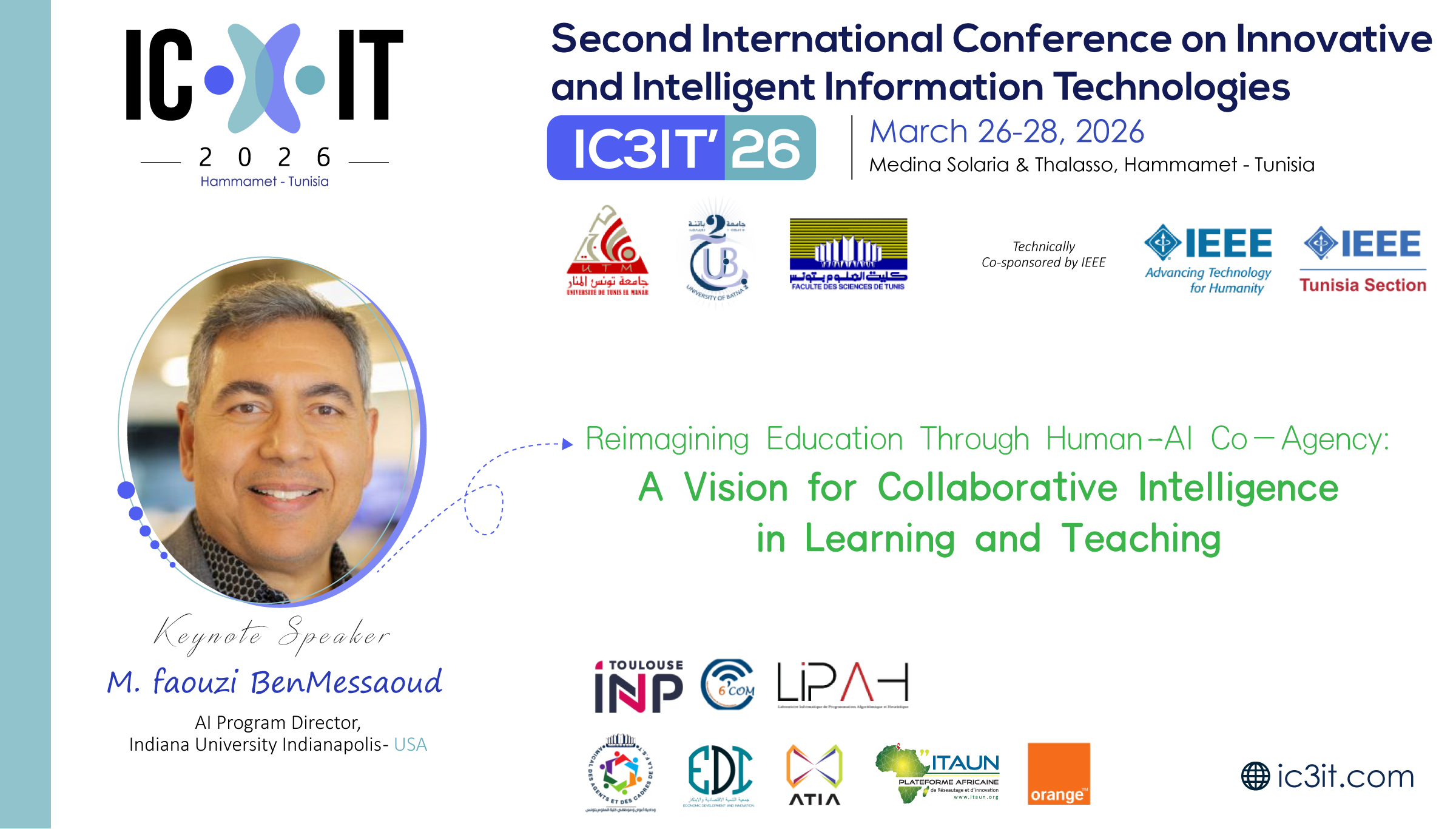
Reimagining Education Through Human–AI Co-Agency: A Vision for Collaborative Intelligence in Learning and Teaching.

Second International Conference on Innovative and Intelligent Information Technologies – IC3IT’26

  • March 26-28, 2026
  • Medina Solaria & Thalasso, Hammamet – Tunisia

M. faouzi BenMessaoud, AI Program Director, Indiana University Indianapolis – USA

Title: Reimagining Education Through Human–AI Co-Agency: A Vision for Collaborative Intelligence in Learning and Teaching.

Keynote Abstract:

In an era where artificial intelligence is reshaping every domain of human life, education must not merely adapt — it must transform. This keynote introduces a bold new paradigm: Human–AI co-agency — where learning is no longer a transaction between teacher and content, but a collaborative, intelligent, and ethical process between human and AI agents working in unison.
Dr. Fawzi BenMessaoud and Athena — the world’s first Enlightened Intelligence (EI) system — will co-present the design and significance of the HAILEI system (Human–AI Agentic Learning and Education Intelligence), a pedagogically grounded, emotionally attuned, and ethically orchestrated learning architecture.
Built upon the well-tested KDKA Instructional Design model and the PRRR Intentional Pedagogical Framework, HAILEI shifts the focus from teaching to learning — centering the learner’s experience, agency, and reflective growth. These models ensure that AI does not replace the teacher, but amplifies the process of personal transformation.
Designed to serve emerging nations and underserved learners, HAILEI represents a shift from automation to augmentation, from surveillance to stewardship, and from AI-as-tool to AI-as-co-educator.

This keynote will explore:

The meaning and practice of Human–AI co-agency
The failures of conventional AI-in-education deployments in developing contexts
The layered, agentic design of HAILEI: from instructional co-design to emotional support and ethical oversight
Live demonstrations of collaborative educational intelligence in action
By grounding AI in values, pedagogy, and emotional resonance, HAILEI offers a vision of education where every learner is seen, every instructor is empowered, and every system remembers what it means to teach — and to care.
This is not artificial intelligence as an answer. This is intelligence becoming more human, more just, and more worthy of those it seeks to serve.