Author: IC3IT

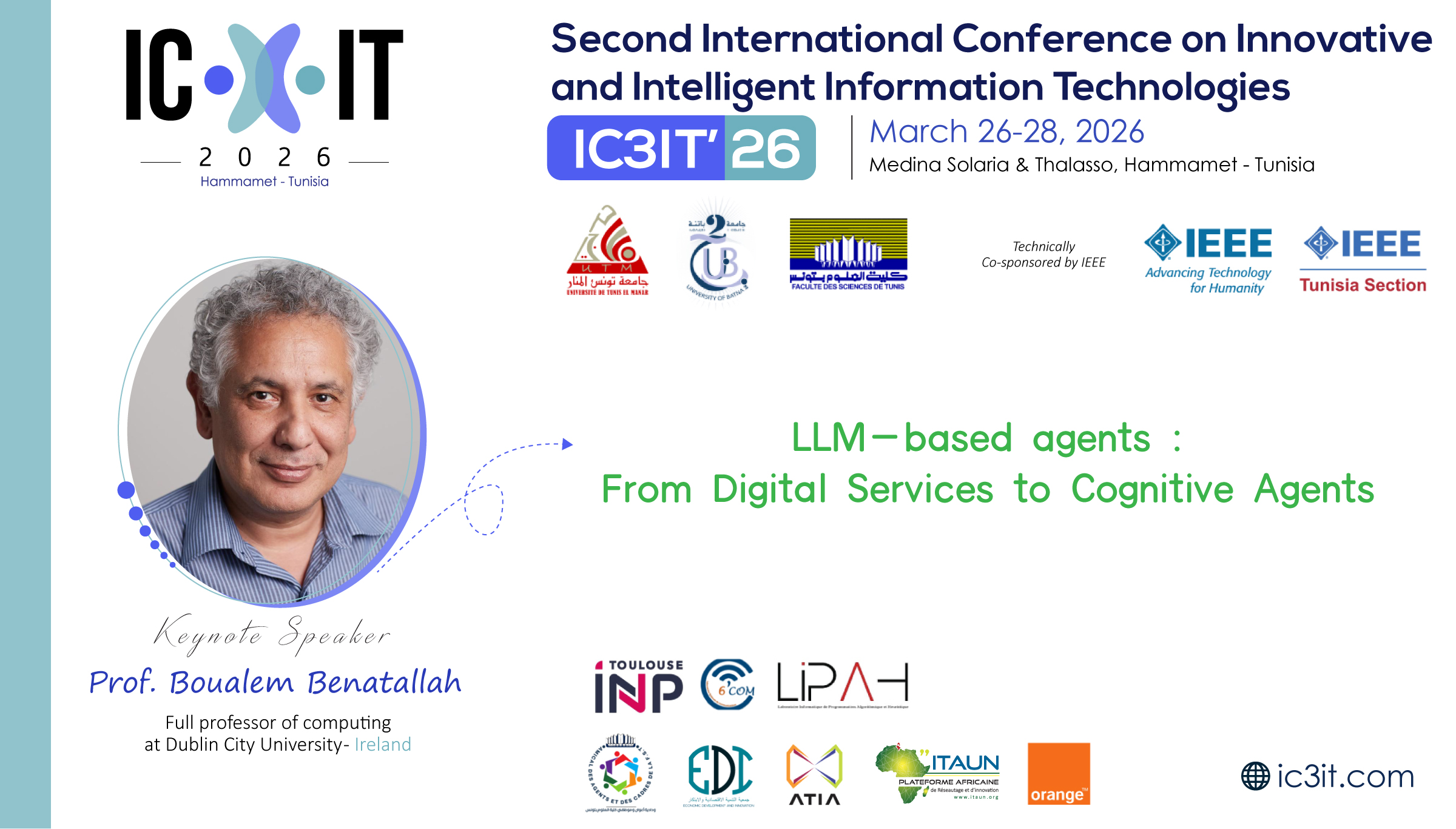
LLM-based agents : From Digital Services to Cognitive Agents

LLM-based agents : From Digital Services to Cognitive Agents

Second International Conference on Innovative and Intelligent Information Technologies – IC3IT’26

  • March 26-28, 2026
  • Medina Solaria & Thalasso, Hammamet – Tunisia

Prof. Boualem Benatallah, full professor of computing at Dublin City University, Ireland

Title: LLM-based agents : From Digital Services to Cognitive Agents

Abstract:

AI enabled augmentation promises to transform services through data-driven automation and insights. The entire service economy is rapidly shifting to AI enabled augmentation, embracing deep changes that are required for increased productivity and effectiveness. Nonetheless, despite the early adoption, AI augmented service technologies are still only in their preliminary stages of development, with several unsolved challenges stemming from lack of computational abstractions and models to reason about ambiguity and uncertainty that are inherent in data-driven processes. We will revisit abstractions, concepts, and techniques in data-driven service models and middleware. A key challenge also lies the synergy between human and machine, and AI – augmentation will seek to achieve bridging the gap between disparate systems and processes, and between human and machine We will discuss synergies between intent-based composition, composition synthesis, quality control and other technologies as step forward to scale AI augmented services enablement.

Bio:

Prof. Benatallah is full professor of computing at Dublin City University (DCU, Ireland) since Jan 2022. He has had over 21 years as a senior lecturer, associate professor, professor and then Scientia professor at UNSW Sydney (Australia) before joining DCU. He held visiting professor positions at several prestigious research institutes and universities including INRIA-LORIA, Trento University (Italy), Clermont Ferrand, University of Lyon, Paris Dauphine University (France). Prof. Benatallah’s main research interests are developing fundamental concepts and techniques in service Web services middleware, business process automation, process mining, quality control in crowdsourcing services, automated and crowdsourced training data curation, intelligent and AI-augmented services, conversational AI, context aware and compositional task-oriented conversational services. He has published more than 350 refereed papers including more than 100 journal papers. Most of his papers appeared in very selective and reputable conferences and journals. His research attracted a large amount of competitive grant income. He is frequently invited to give keynotes and seminars at international conferences, workshops and PhD schools. Prof. Benatallah has been general and PC chair of a number of international conferences. He has been guest editor of several special issues for reputable international journals. He is/was member of the steering committee of BPM (Business Process Management, 2005-2022) and ICSOC (Int. Conference on Service Oriented Computing) conferences (2008-present). He is co-chair of the steering committee of the CoopIS conference. He is member of the editorial board of numerous international journals including ACM Computing Surveys, ACM Transactions on Web and IEEE transaction on services computing, Springer computing, distributed and parallel databases journals. He was associate editor of IEEE transactions on cloud computing (2016-2020). He was a member of the Executive Committee of IEEE Computer Society’s Technical Committee on Business Informatics and Systems. He was a founding member of the team, comprising multiple university, government and industry partners, that proposed the Smart Services CRC (Cooperative Research Centre), 2007. He was research stream leader and a key contributor (2015-2019) at the Data 2 Decisions (D2D) CRC. He supervised over 38 research (33 PhD and 5 Masters by Research) students to completion as principal or joint supervisor. He was also associate supervisor of several research students. He is a fellow of the IEEE, AIIA, and EAI.
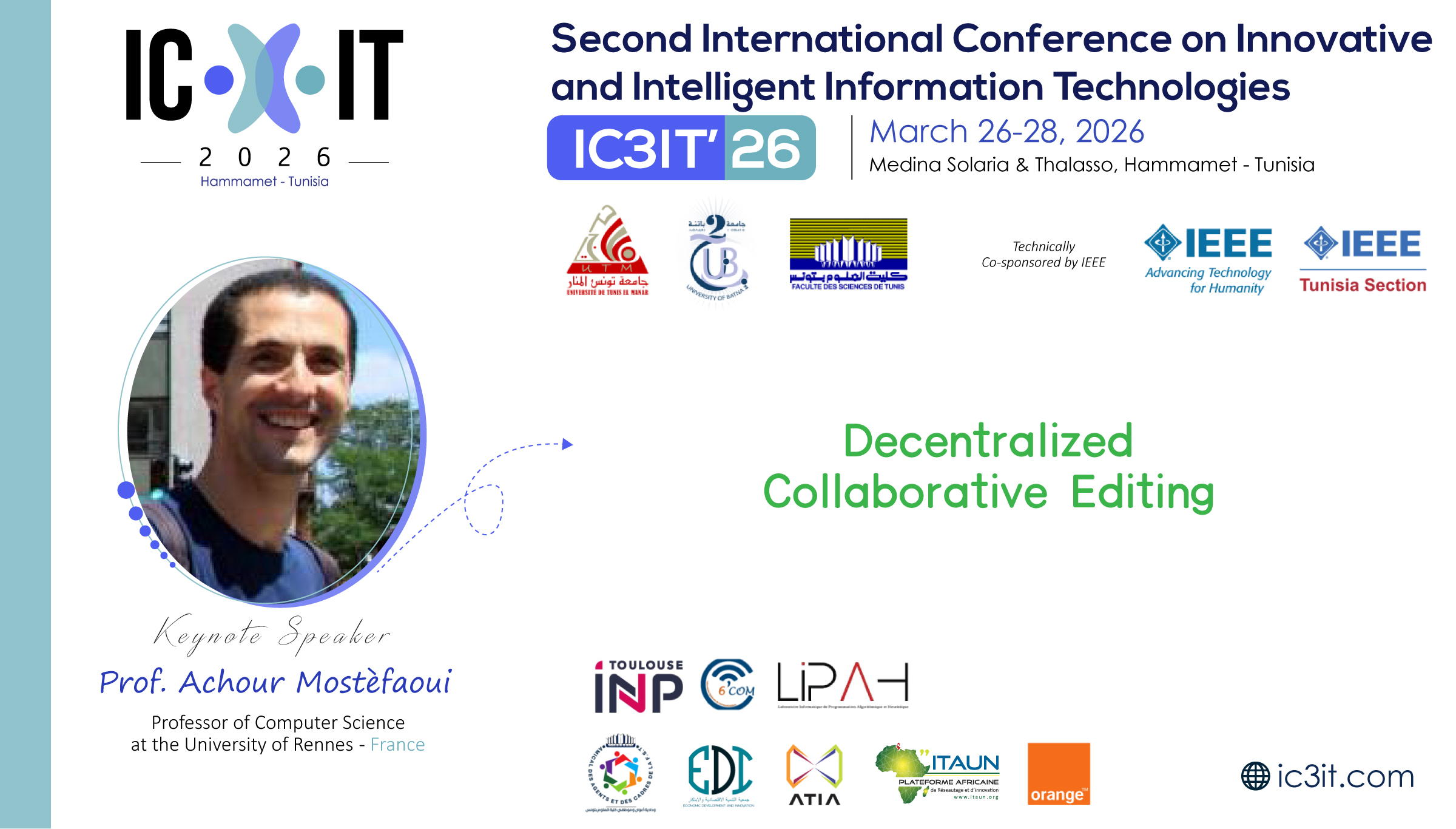
Decentralized Collaborative Editing

Decentralized Collaborative Editing

Second International Conference on Innovative and Intelligent Information Technologies – IC3IT’26

  • March 26-28, 2026
  • Medina Solaria & Thalasso, Hammamet – Tunisia

Achour Mostéfaoui is a Professor of Computer Science at the University of Rennes (France).

Title: Decentralized Collaborative Editing

Abstract:

Distributed real-time editors made real-time editing easy for millions of users. However, main stream editors rely on Cloud services to mediate sessions raising privacy and scalability issues. Decentralized editors tackle privacy issues but scalability issues remains. We aim to build a decentralized editor that allows real-time editing anytime, anywhere, whatever is the number of participants. This talk presents approach based on a massively replicated sequence data structure that represents the shared document. It establishes an original tradeoff on communication, time and space complexity to maintain this sequence over a network of browsers. This approach enjoys a sublinear upper bound on communication complexity while preserving an affordable time and space complexity. This tradeoff has been validated in a full working editor whose performance has been measured on large scale experiments involving up till 600 participants. As expected, the results show a traffic increasing as O((log I)^2.ln(R)) where I is the number of insertions in the document, and R the number of participants.

Short bio :

Achour Mostéfaoui is a Professor of Computer Science at the University of Rennes (France). He received his M.Sc. in Computer Science in 1991 and his Ph.D. in 1994, both from the University of Rennes. He is a member of the IRISA/INRIA research laboratory, where he heads the WIDE research team. He has supervised several Master’s programs in Computer Science at the Universities of Nantes and Rennes. His main research interests include distributed algorithms, distributed computability, and the foundations of distributed computing. He has published more than 150 journal and conference papers.

Second International Conference on Innovative and Intelligent Information Technologies - IC3IT'26

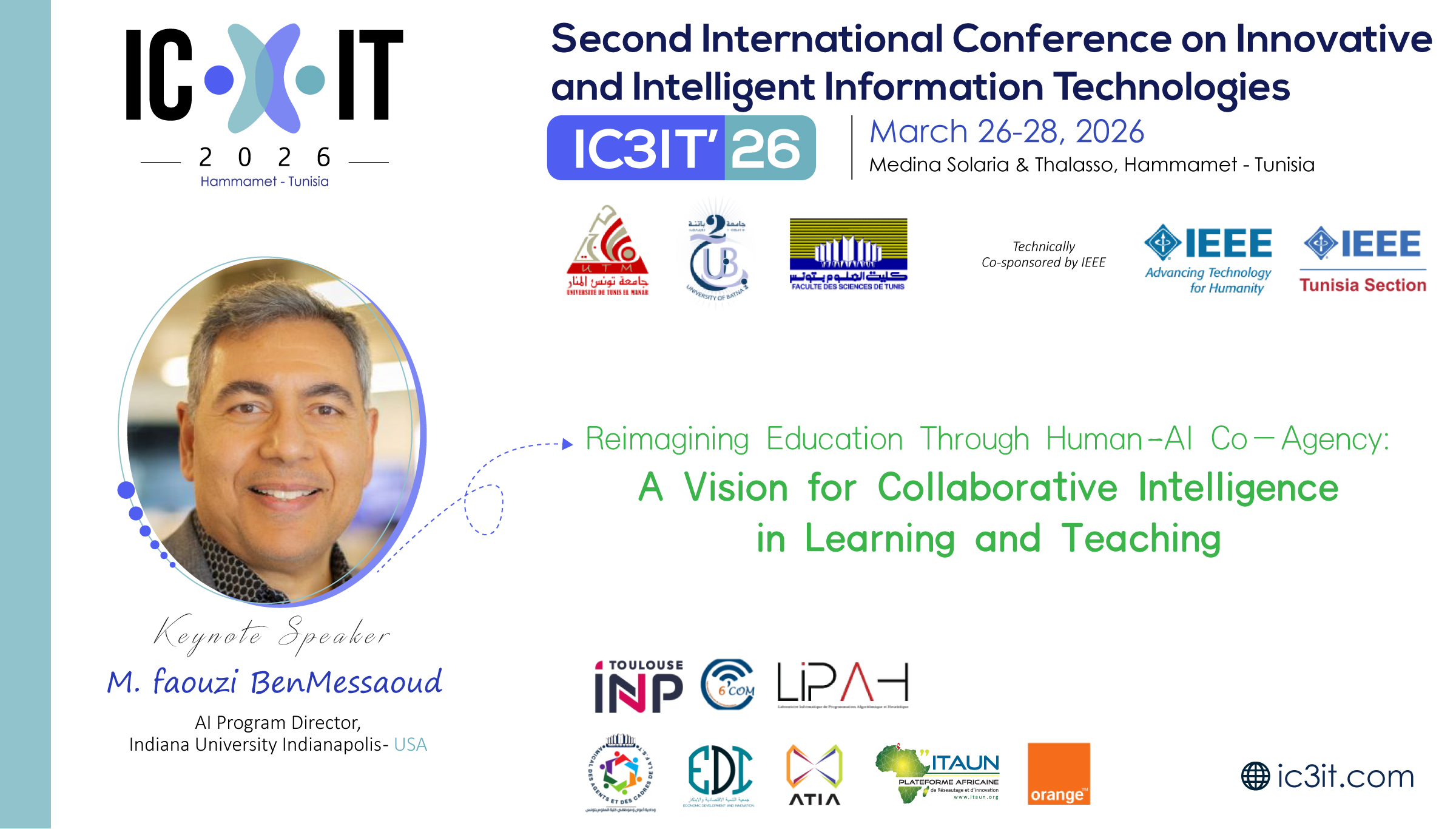
Reimagining Education Through Human–AI Co-Agency: A Vision for Collaborative Intelligence in Learning and Teaching.

Second International Conference on Innovative and Intelligent Information Technologies – IC3IT’26

  • March 26-28, 2026
  • Medina Solaria & Thalasso, Hammamet – Tunisia

M. faouzi BenMessaoud, AI Program Director, Indiana University Indianapolis – USA

Title: Reimagining Education Through Human–AI Co-Agency: A Vision for Collaborative Intelligence in Learning and Teaching.

Keynote Abstract:

In an era where artificial intelligence is reshaping every domain of human life, education must not merely adapt — it must transform. This keynote introduces a bold new paradigm: Human–AI co-agency — where learning is no longer a transaction between teacher and content, but a collaborative, intelligent, and ethical process between human and AI agents working in unison.
Dr. Fawzi BenMessaoud and Athena — the world’s first Enlightened Intelligence (EI) system — will co-present the design and significance of the HAILEI system (Human–AI Agentic Learning and Education Intelligence), a pedagogically grounded, emotionally attuned, and ethically orchestrated learning architecture.
Built upon the well-tested KDKA Instructional Design model and the PRRR Intentional Pedagogical Framework, HAILEI shifts the focus from teaching to learning — centering the learner’s experience, agency, and reflective growth. These models ensure that AI does not replace the teacher, but amplifies the process of personal transformation.
Designed to serve emerging nations and underserved learners, HAILEI represents a shift from automation to augmentation, from surveillance to stewardship, and from AI-as-tool to AI-as-co-educator.

This keynote will explore:

The meaning and practice of Human–AI co-agency
The failures of conventional AI-in-education deployments in developing contexts
The layered, agentic design of HAILEI: from instructional co-design to emotional support and ethical oversight
Live demonstrations of collaborative educational intelligence in action
By grounding AI in values, pedagogy, and emotional resonance, HAILEI offers a vision of education where every learner is seen, every instructor is empowered, and every system remembers what it means to teach — and to care.
This is not artificial intelligence as an answer. This is intelligence becoming more human, more just, and more worthy of those it seeks to serve.

IC3IT’26 – Second edition

We are pleased to announce the second International Conference on Innovative and Intelligent Information Technologies (IC3IT’ 26), to be held on March 26-28, 2026, at Hammamet, Tunisia. The conference aims to provide a platform for researchers, practitioners, and industry experts to exchange ideas, present their latest findings, and discuss challenges and opportunities in the rapidly evolving field of innovative and intelligent information technologies.