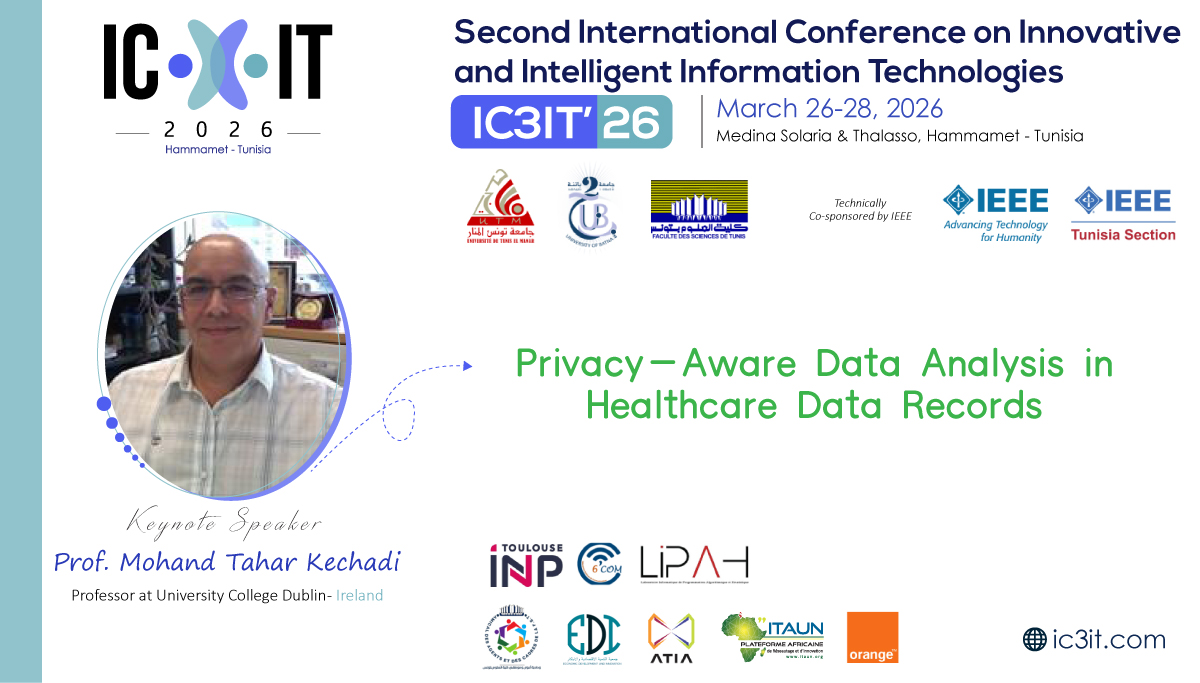
Privacy-Aware Data Analysis in Healthcare Data Records
Second International Conference on Innovative and Intelligent Information Technologies – IC3IT’26
- March 26-28, 2026
- Medina Solaria & Thalasso, Hammamet – Tunisia
Mohamed Tahar Kechadi, Professor at University College Dublin-Ireland
Title: Privacy-Aware Data Analysis in Healthcare Data Records
Abstract :
In the healthcare sector, large amounts of data about patients, their medical conditions, and practices have been collected through clinical databases and other healthcare processes. Currently, these systems record nearly all aspects of care, including patient personal information, clinical trials, hospital records, diagnoses, medications, test results, imaging data, costs, and administrative reports. As in other application domains, the big data revolution also holds great promise in healthcare, as the available data on individual patients is very rich and contains crucial knowledge that can be exploited to improve patient care, accelerate research, and reduce costs. For instance, Global healthcare data is growing exponentially, with estimates projecting a rise from approximately 2.3 zettabytes (ZB) to over 10.8 ZB in 2025, representing a 36% annual growth rate. Healthcare data accounts for nearly 30% of the world’s total data, driven by electronic health records, imaging, and connected devices. Turning this massive amount of data into knowledge that can be used to identify needs, predict and prevent critical patient conditions, and help practitioners make rapid, accurate decisions is not only desirable but also an urgent necessity. Therefore, healthcare organizations must be able to manage and analyse their data rapidly and efficiently to answer critical questions about diseases, treatments, patient behaviour, and care management. However, building such a system faces significant challenges: 1) data complexity, 2) privacy, security, ethical, legal, and social issues, and 3) interoperability, portability, and compatibility. In this presentation, we will discuss privacy issues in healthcare data by designing and building a privacy-aware protocol for healthcare data analysis. The solution is presented based on well-defined requirements to demonstrate its applicability and efficiency.
Biography:
Professor M-Tahar Kechadi obtained a PhD and MSc degrees in Computer Science from the University of Lille 1, France. He is currently a full professor of data science at the School of Computer Science, UCD. He is a PI at the Insight Centre for Data Analytics and a PI at the Co-Centre for Sustainable Food Systems. Professor Kechadi is a specialist in AI and Cybersecurity with extensive experience in machine learning, particularly in understanding dataset characteristics. He has a strong background in managing and analysing data quickly and efficiently. Big data will continue to grow exponentially, underpinning new waves of innovation across nearly every sector of the global economy and reshaping how we build and use computers (hardware and software). Professor Kechadi is a PI in many large research centres in Ireland (including the Insight Centre for Data Analytics, Co-Centre for Sustainable Food Systems, …) and has contributed to numerous large-scale AI projects, ranging from multimodal healthcare data to NLP models for fake news detection and digital agriculture. His work in privacy-preserving analytics has added an extra dimension to addressing ethical and privacy considerations in the development of future AI. Moreover, he has served as the Chair of numerous conferences and workshops. He serves on the scientific committees of several international conferences and has organized and hosted leading conferences in his field. He has established and maintained collaborations with CERN, including student co-supervision, software development, data analysis, and EU project collaborations. He has been a visiting professor at many universities, including Liverpool, Fuzhou, Artois, Lille, …). Currently, he is an adjunct professor at Dalian University of Technology and a member of the Expert Advisory Committee for Intelligent Cyber-Physical Systems, another area of research in which AI technologies are crucial.